Description
Metal-organic chemical vapor deposition (MOCVD) is a specialized form of chemical vapor deposition used to grow high-quality, single-crystal compound semiconductor thin films, particularly III–V materials such as gallium arsenide (GaAs), gallium antimonide (GaSb), indium phosphide (InP), gallium nitride (GaN), and aluminum nitride (AlN). In this process, metal-organic precursors (e.g., trimethylgallium, trimethylaluminum, and trimethylindium) and hydride gases (e.g., arsine, phosphine, and ammonia) are introduced into a heated reaction chamber, where they decompose and react at the substrate surface to form a crystalline film.
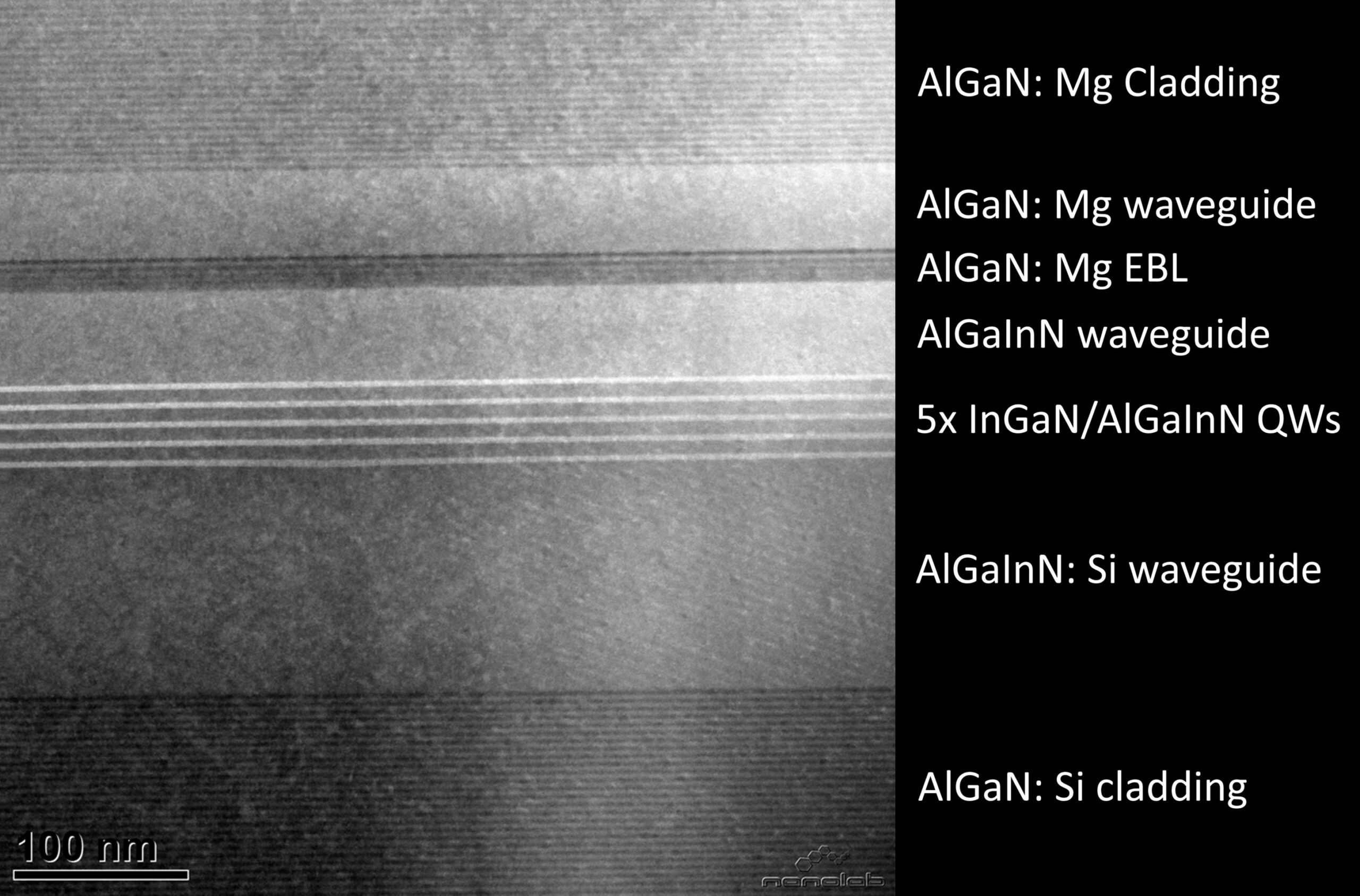
MOCVD enables the epitaxial growth of complex multilayer semiconductor structures with atomically abrupt interfaces. These structures may be grown on lattice-matched substrates, as strained layers on lattice-mismatched substrates, or as metamorphic layers using compositionally graded buffer regions. Such flexibility supports the fabrication of advanced devices including laser diodes, LEDs, photodetectors, and power amplifiers. The technique provides precise control over material composition, thickness, and doping, enabling the design of heterostructures with tailored electronic and optical properties through bandgap engineering.
In pseudomorphic epitaxy, the deposited layer adopts the in-plane lattice constant of the substrate despite having a different natural lattice parameter. This results in elastic strain within the epilayer, allowing it to remain coherent with the substrate and suppress the formation of misfit dislocations. This approach enables the integration of materials with differing lattice constants, such as InGaN on GaN, within a single device structure.
In contrast, metamorphic epitaxy accommodates lattice mismatch through the use of compositionally graded buffer layers that gradually relax strain. Additional techniques, such as short-period superlattices, can be employed to deflect threading dislocations and confine defects within the buffer region. This approach enables the integration of materials that cannot be directly grown on one another, thereby overcoming lattice-matching constraints and expanding the accessible range of bandgaps for device applications.
We have extensive experience with a wide range of epitaxial growth techniques and device heterostructures.
What We Offer
We offer custom MOCVD epitaxial growth of compound semiconductor heterostructures tailored to your specific requirements and designs. We work closely with you to understand your target structure and leverage decades of experience to optimize the growth process for your application. Our deliverables include high-quality epitaxial wafers accompanied by comprehensive characterization data.
We can also perform wafer-scale Zn diffusion, epitaxial regrowth, and Fe-doped semi-insulating InP regrowth.
Example device epilayers include Fabry Perot laser diodes (Red, IR, blue and UV (369 nm)), LEDs, VCSELs, PIN photodiodes, Avalanche photodetectors, thermophotovoltaics.
Materials
| Material System | Ternaries | Quaternaries | p-dopant | n-dopant |
|---|---|---|---|---|
| GaAs | AlGaAs, InGaAs, InGaP | InGaAsP, InAlGaP | Zn, C | Si, Te |
| InP | InGaAs, InAlAs, GaAsSb | InGaAsP, InAlGaAs | Zn, C | Si, Te |
| GaSb | InAsSb, AlGaSb | InGaAsSb, AlGaAsSb, InAsSbP | Zn, C | Si, Te |
| GaN Substrates: Bulk GaN or Sapphire | InGaN, AlGaN | InAlGaN | Mg | Si |
| AlN Substrates: Bulk AlN or Sapphire | InGaN, AlGaN | InAlGaN | Mg | Si |
“Being able to participate in the MOCVD growth, device fabrication, and characterization … directly is a great strength of the program in progress. I especially appreciate the detailed preparation and the execution by the PARC/SRI team members.”
S.R., Research Fellow, LED R&D Center
Client company manufacturer of mobile phone camera modules, automotive electronics, and semiconductor substrates
On the co-development of optoelectronic light-emitters.